
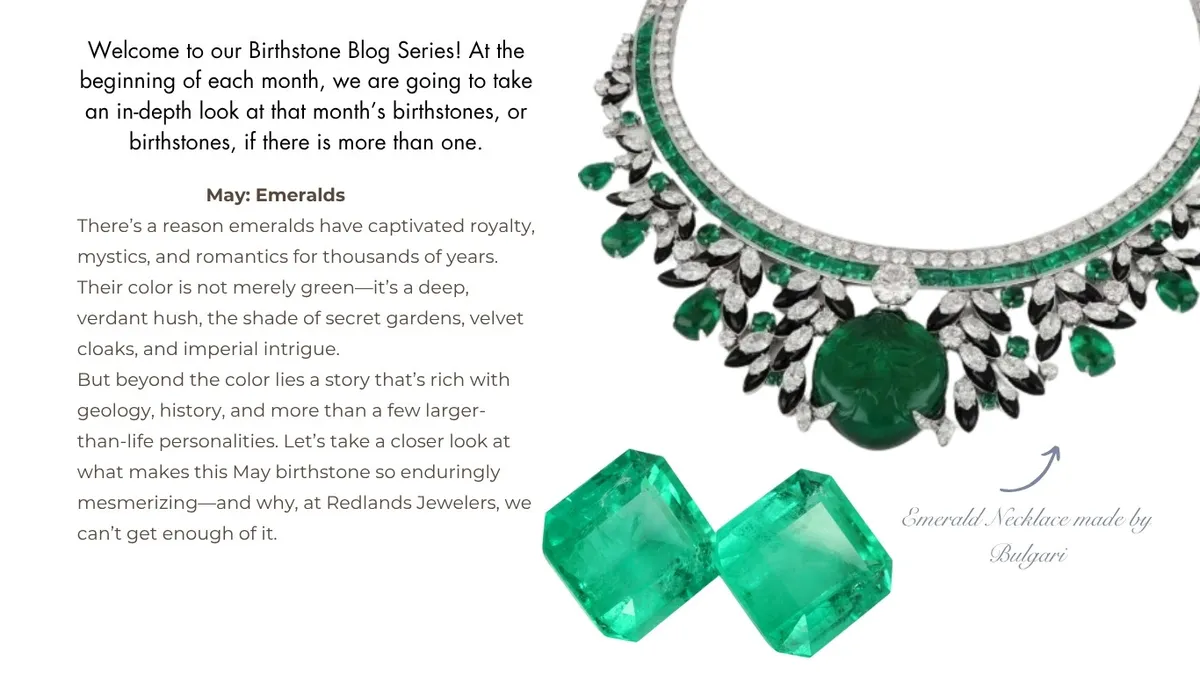
Welcome to our Birthstone Blog Series! At the beginning of each month, we take an in-depth look at that month’s birthstone—or birthstones, if there is more than one.
Emeralds are not just beautiful—they’re captivating. Each emerald is a world unto itself: vibrant, mysterious, and utterly unique. With their rich green glow and fascinating inclusions, emeralds possess a depth and personality that few other gemstones can rival.
Often described as the Audrey Hepburn of the gem world, emeralds are timeless, graceful, and impossible to imitate.
At Redlands Jewelers, we work with some of the most reputable emerald sources in the world. If you’re ready to create something extraordinary, we’re here to help you find the perfect emerald to bring your vision to life.
May Birthstone: Emerald
There’s a reason emeralds have captivated royalty, mystics, and romantics for thousands of years. Their color is not merely green—it’s a deep, verdant hush reminiscent of secret gardens, velvet cloaks, and imperial intrigue.
Beyond their striking color lies a rich story shaped by geology, history, and symbolism, making emeralds one of the most meaningful gemstones in the world.
Natural vs. Synthetic Emeralds: A Tale of Two Origins
By the early 20th century, scientists sought to recreate emeralds—drawn not only by their beauty but by the challenge of mimicking nature’s complexity. This led to the creation of synthetic emeralds, which are chemically identical to natural emeralds but grown in controlled laboratory environments.
The first successful synthetic emeralds were produced in the 1930s by French chemist Pierre Gilson. Modern lab-grown emeralds are created using hydrothermal or flux-growth methods that replicate the extreme heat and pressure found deep within the Earth.
While visually stunning and often more affordable, synthetic emeralds typically lack the natural inclusions and subtle irregularities that give natural emeralds their unmistakable character.
At Redlands Jewelers, we’re happy to help you explore both natural and lab-created emeralds so you can choose the stone that best reflects your style and values.
A Gentle Touch: Emerald Treatments & Care
Emeralds are treasured not only for their vivid color but also for their natural character, which often includes internal features known as inclusions. To enhance clarity and beauty, most emeralds are traditionally treated with oil.
Because of their unique structure, emeralds require gentle care. Avoid ultrasonic cleaners, steam, and harsh chemicals. Instead, clean emerald jewelry with a soft cloth and mild soapy water.
Remove emerald jewelry during sports, heavy work, or gardening. Store emeralds separately from harder gemstones and bring them to a trusted jeweler for periodic inspection and maintenance.
Inclusions: The Secret World Inside Emeralds
No two emeralds are ever exactly alike—and that’s part of their charm. Unlike gemstones prized for flawless clarity, emeralds embrace their imperfections.
These internal features, known as inclusions, are often referred to as jardin (French for “garden”). They may resemble moss, winding roots, watery landscapes, or delicate veils suspended within the stone.
Common emerald inclusions include liquid-filled cavities, tiny gas bubbles, crystals of other minerals, and feather-like fractures. Rather than detracting from the gem, these features offer a glimpse into the earth’s geological history.
Notable Emerald Inclusions
- Three-phase inclusions: Containing solid, liquid, and gas—highly prized by gemologists
- Pyrite crystals: Golden flecks often found in Colombian emeralds
- Feather-like fractures: Wispy inclusions that add a soft, dreamy appearance
Emeralds of Fame and Folklore
Emeralds have long been associated with power, wisdom, and extravagant beauty. Some of history’s most famous emeralds include:
- The Duke of Devonshire Emerald: An uncut 1,383-carat marvel housed at the British Museum
- The Cambridge Emeralds: Once won in a lottery, now part of a private royal collection
- The Mogul Mughal Emerald: A 217-carat carved emerald from 1695 that fetched over $2 million at auction
- Elizabeth Taylor’s Emerald Suite: A legendary Bulgari collection gifted by Richard Burton
- Cleopatra’s emeralds: Because, of course
Historically, emeralds were believed to soothe the soul, ward off evil, and even improve memory—though we can’t promise they’ll help you remember where you left your keys.
From Cleopatra’s Mines to Colombian Legends
The earliest recorded emerald mines date back to ancient Egypt around 330 BCE and were famously favored by Cleopatra. She adorned herself and her court with emeralds and even gifted carved emeralds bearing her likeness to visiting dignitaries.
In the 1500s, emeralds were discovered in Colombia—now considered the world’s premier source. Mines such as Muzo, Chivor, and Coscuez produce emeralds renowned for their vivid color and exceptional quality.
Notable emerald sources today include Zambia, Brazil, Ethiopia, Pakistan, and Afghanistan—each producing stones with distinct characteristics.
The Science of Emeralds: A Botanical Wonder Born of Bedrock
Emeralds are a variety of the mineral beryl, with the chemical formula Be3Al2(SiO3)6. Pure beryl is colorless; trace elements such as chromium, vanadium, and iron give emeralds their iconic green color.
Chromium-rich Colombian emeralds display a vivid bluish-green hue, while vanadium-rich Zambian emeralds often lean toward deeper forest tones.
Emeralds form under exceptionally rare geological conditions, requiring incompatible elements to converge during metamorphic activity. This rarity explains both their value and their characteristic inclusions.
On the Mohs scale, emeralds rate between 7.5 and 8—making them reasonably hard but more brittle than diamonds, and deserving of mindful wear.