
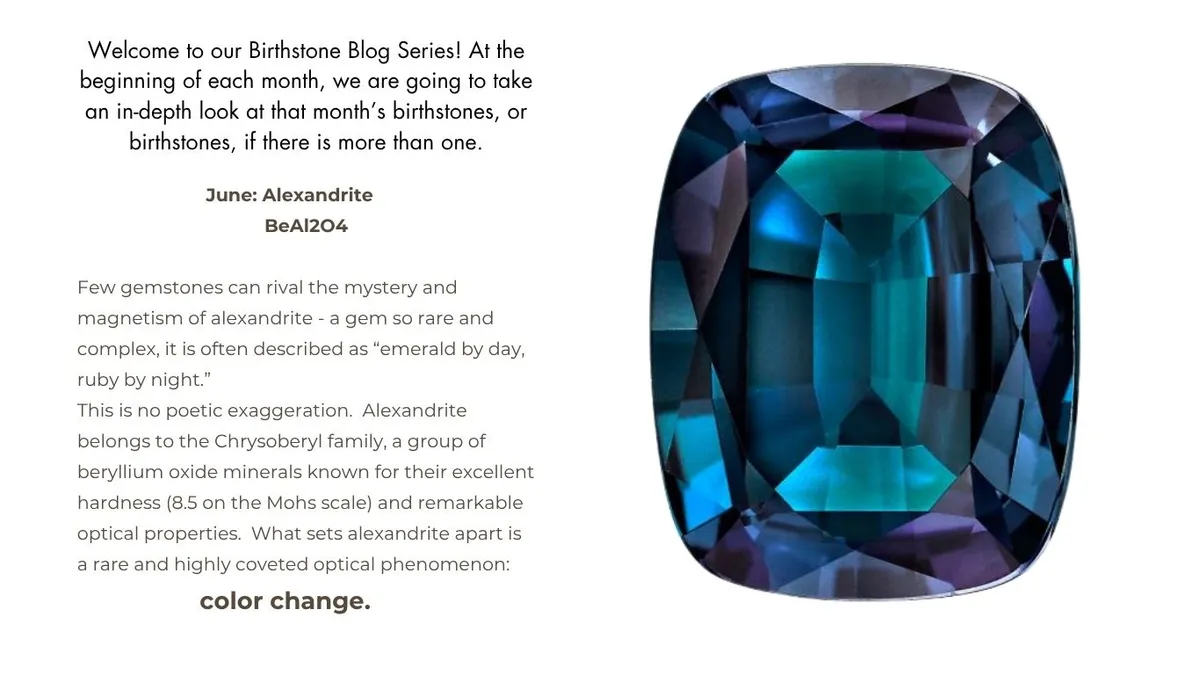
Alexandrite: The Stone of Duality, Depth, and Color Change
Welcome to our Birthstone Blog Series! At the beginning of each month, we take an in-depth look at that month’s birthstone—or birthstones, if there is more than one.
Alexandrite is one of the rarest and most fascinating gemstones in the world. Known for its dramatic color-changing ability—green in daylight and red under incandescent light—it has captivated gem collectors, royalty, and jewelry lovers for nearly two centuries.
This article explores the history, science, symbolism, rarity, and famous examples of alexandrite, reformatted from PDF into an SEO-friendly web format.
June Birthstone: Alexandrite
Few gemstones can rival the mystery and magnetism of alexandrite. Often described as “emerald by day, ruby by night,” alexandrite belongs to the chrysoberyl family and has the chemical composition BeAl2O4.
With a Mohs hardness of 8.5, alexandrite is both durable and exceptionally rare. What truly sets it apart is its extraordinary color-change phenomenon.
Famous Alexandrites of the World
The Smithsonian Alexandrite
- Origin: Sri Lanka
- Carat Weight: 66.7 carats
- Location: Smithsonian Institution, Washington D.C.
This is one of the largest and finest faceted alexandrites in existence, displaying a dramatic green-to-red color shift. It is part of the National Gem Collection and was donated by a private collector.
The Whitney Alexandrite
- Origin: Brazil
- Carat Weight: 17.08 carats
- Location: Smithsonian Institution, Washington D.C.
Donated by the Whitney family, this gemstone is considered a prime example of Brazilian alexandrite, admired for its strong color shift and exceptional clarity.
Russian Imperial Alexandrites
- Origin: Ural Mountains, Russia
- Carat Weight: Typically under 5 carats
Mined in the 19th century, these alexandrites were favored by the Romanov royal family. Due to their provenance and rarity, they fetch exceptionally high prices at auction.
The Sauer Alexandrite
- Origin: Bahia, Brazil
- Carat Weight: Over 122,000 carats (rough)
Discovered in 1967, this is the largest known uncut alexandrite specimen. Its current location is unknown, making it one of the most intriguing lost gemstone treasures in history.
Celebrities and Alexandrite
Alexandrite has appeared in notable celebrity jewelry collections. Actress Anna Faris has worn an alexandrite brooch, while Felicity Huffman has been seen wearing a large alexandrite ring, highlighting the gemstone’s timeless elegance.
A Stone of Duality and Transformation
Throughout history, alexandrite has symbolized balance, transformation, and clarity. In Russian folklore, it was believed to bring good fortune, self-discipline, and success—especially to those in power.
In metaphysical traditions, alexandrite is associated with intuition, emotional balance, and personal growth. Its shifting colors represent adaptability and the ability to see multiple perspectives.
Natural vs. Synthetic Alexandrite
Synthetic alexandrite has been produced since the 1960s using flux and Czochralski growth methods. These lab-created stones often display unusually clean interiors, curved growth striations, or metallic platelets when viewed under magnification.
Many so-called “lab-created alexandrites” are actually color-change synthetic corundum. Advanced gemological testing is required to determine true identity.
Sources and Rarity
Although alexandrite was first discovered in Russia’s Ural Mountains in 1834, modern sources include:
- Brazil: Often larger stones, sometimes with gray modifiers
- Sri Lanka: Cleaner stones with less dramatic color change
- Africa: Promising material, especially under 1 carat with strong color shift
Fine-quality natural alexandrite remains exceptionally rare and highly prized.
The Science Behind Alexandrite’s Color Change
Alexandrite’s color change occurs due to trace amounts of chromium replacing aluminum ions in its crystal structure. Chromium absorbs light differently depending on the light source.
- Daylight / Fluorescent Light: Bluish-green to teal
- Incandescent / Candlelight: Purplish-red to raspberry hues
This unique interaction between light and chromium gives alexandrite its legendary optical magic.
A Gem Fit for a Tsar—and You
Named in honor of Russian Crown Prince Alexander II, alexandrite became a symbol of imperial prestige. While once reserved for royalty, it is now accessible through both natural and lab-created options.
Alexandrite remains one of the most captivating gemstones in the world—an enduring symbol of rarity, beauty, and transformation.