
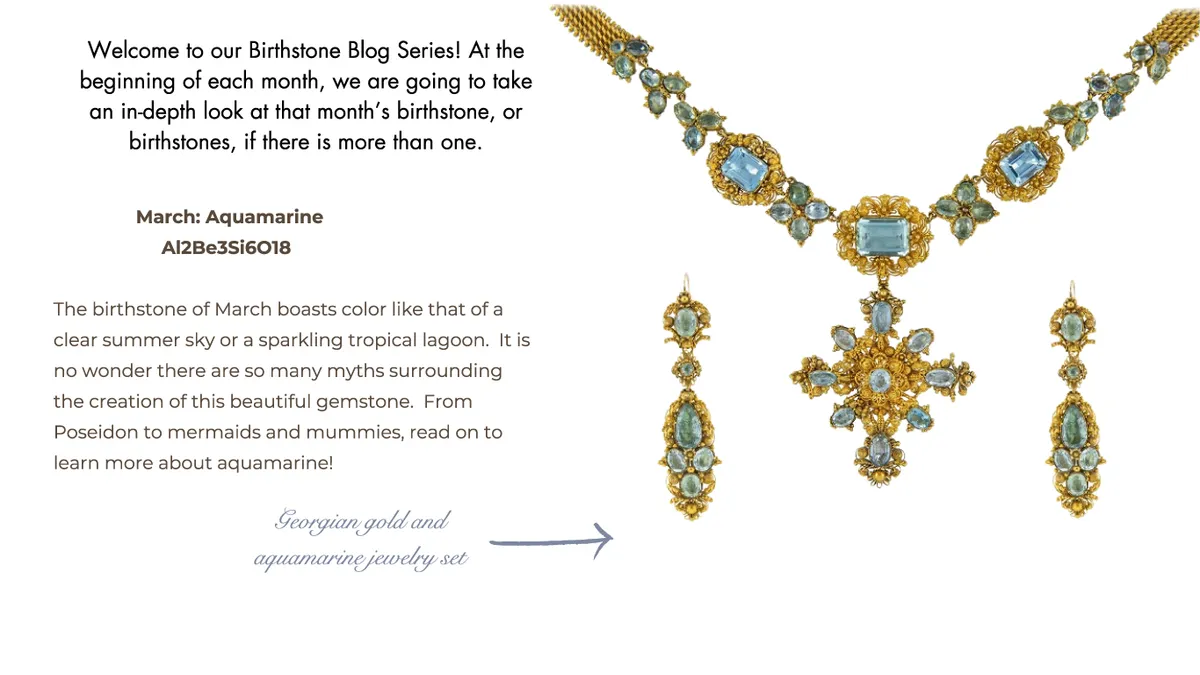
Aquamarine: March’s Crystal-Clear Birthstone of the Sea
Welcome to our Birthstone Blog Series! At the beginning of each month, we take an in-depth look at that month’s birthstone—or birthstones, if there is more than one.
The birthstone of March, aquamarine boasts a color reminiscent of a clear summer sky or a sparkling tropical lagoon. Whether you are celebrating a March birthday, a 19th wedding anniversary, or simply love this serene blue hue, aquamarine has a timeless appeal.
At Redlands Jewelers, we would love to help you explore beautiful aquamarine jewelry and answer any questions you may have about this captivating gemstone.
March Birthstone: Aquamarine
Aquamarine belongs to the beryl family, sharing its lineage with emerald and morganite. Its chemical composition is Al2Be3Si6O18, and it owes its blue to blue-green tones to the presence of iron.
Long associated with the sea, aquamarine has inspired myths of Poseidon, mermaids, sailors, and ancient travelers who believed the stone offered protection and safe passage.
Care and Cleaning of Aquamarine
Aquamarine is a durable gemstone, measuring 7.5–8 on the Mohs hardness scale, making it suitable for daily wear with proper care.
When not being worn, store aquamarine jewelry in a dry place away from other pieces to prevent scratching or abrasion. As with all gemstones, it should be kept away from harsh household chemicals.
To clean aquamarine jewelry, use warm water mixed with a small amount of mild dish soap. Allow the jewelry to soak briefly, then gently clean it with a soft-bristled toothbrush. Rinse thoroughly and pat dry with a soft cloth.
For a deeper professional cleaning, bring your aquamarine jewelry to Redlands Jewelers.
Aquamarine Throughout the Decades
Aquamarine jewelry has evolved beautifully through time, reflecting the design styles of each era:
- 1850s: Ornate settings with intricate metalwork
- 1910s: Delicate designs accented with pearls
- 1920s–1930s: Art Deco influences with geometric cuts
- 1940s: Bold, architectural gold settings
- 1960s: Sculptural and organic forms
- 1980s: Larger stones with dramatic presence
Celebrities Wearing Aquamarine
Aquamarine has long been a favorite among celebrities for its elegance and soft brilliance.
- Jessica Biel (2014) wore stunning aquamarine jewelry on the red carpet
- Karlie Kloss (2013) showcased aquamarine earrings at a major awards event
- Emmy Rossum (2013) wore aquamarine at Elton John’s Oscar Party
Mining and Treatments
Aquamarine has been used since as early as 500 BC. The first major deposits were discovered in Siberia in 1723, and by the late 1700s, aquamarine was widely traded throughout Western Europe.
Formed primarily in granite pegmatite veins, aquamarine develops when hot, mineral-rich water saturates the rock. As a member of the beryl family, aquamarine’s color is created by iron within the crystal structure.
Today, aquamarine is mined in many regions worldwide, including Brazil, Siberia, the United States, Nigeria, Madagascar, Mozambique, Zambia, and Pakistan.
Many aquamarines receive a gentle heat treatment to deepen the blue color and reduce green tones. This treatment is permanent, stable, and widely accepted within the gemstone industry. Untreated aquamarines, prized for their natural hues, have also grown in popularity in recent years.
Symbolism, Love, and Tradition
Historically, aquamarine has been associated with feminine energy and was often carved into the likenesses of goddesses. Across cultures, it has been linked to Kupala, Kwan-yin, Fuji, and Akna—goddesses of water, mercy, fire, and motherhood.
In Buddhist tradition, aquamarine jewelry is given from husband to wife the day after their wedding to promote harmony and contentment. This belief spread through medieval Europe, and aquamarine remains the traditional gift for the 19th wedding anniversary.
In modern history, Prince Harry honored this tradition by gifting Meghan Markle Princess Diana’s aquamarine ring, further cementing the gemstone’s association with love and legacy.
Ancient Legends of Aquamarine
The ancient Romans believed aquamarine could improve vision—Emperor Nero was said to look through slices of aquamarine placed over his eyes. It was also believed to help foretell the future and reconcile enemies.
In 1379, William Langland wrote in The Vision Concerning Piers the Plowman that aquamarine could protect its wearer from poison. Because of this, medieval royalty often carried or wore the stone.
Roman mythology claimed Poseidon created aquamarine from sea water, and sailors believed the stone washed ashore from the treasure chests of sirens. During dangerous voyages, aquamarine was sometimes thrown into the sea to appease them.
From ancient tombs to royal collections, aquamarine has remained a gemstone of protection, clarity, and calm for thousands of years.