
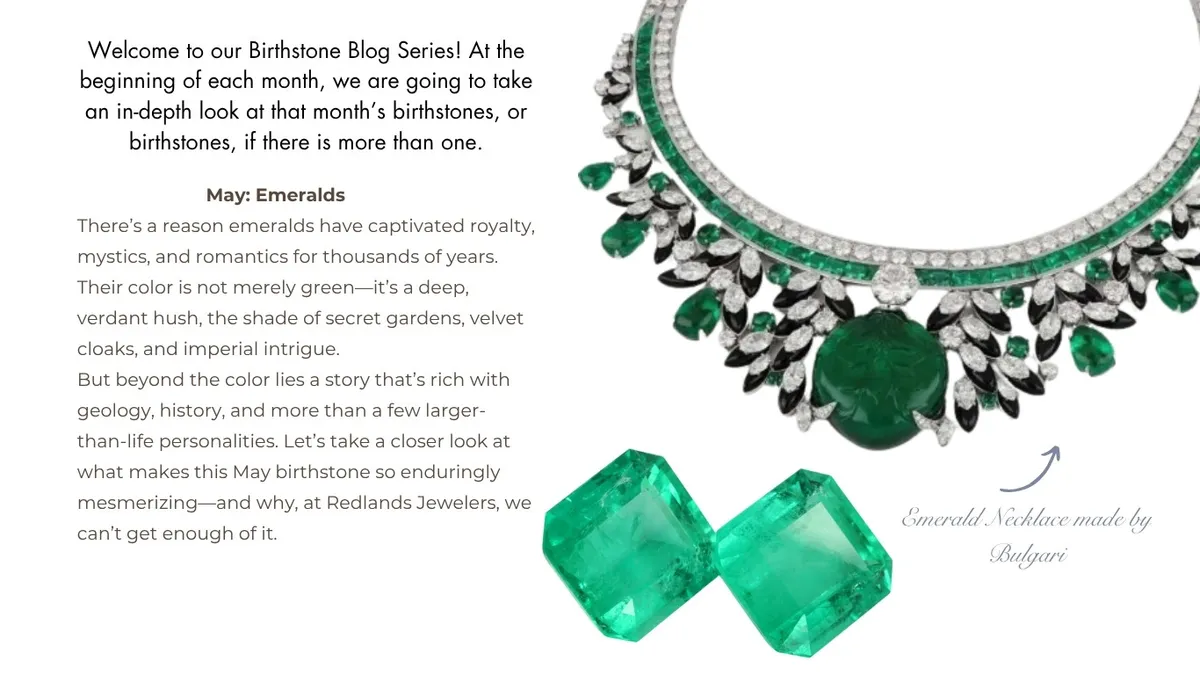
Welcome to our Birthstone Blog Series! At the beginning of each month, we take an in-depth look at that month’s birthstone. Few gemstones can rival the mystery and magnetism of Alexandrite — a gem so rare and complex it’s often described as “emerald by day, ruby by night.”
June Birthstone: Alexandrite
Chemical Formula: BeAl2O4
Alexandrite belongs to the chrysoberyl family, a group of beryllium oxide minerals known for exceptional hardness (8.5 on the Mohs scale) and remarkable optical properties. What truly sets alexandrite apart is its rare and highly coveted optical phenomenon: color change.
A Stone of Duality and Depth
Throughout history, alexandrite has been seen as a stone of duality and transformation, mirroring its dramatic shift between green and red hues. In Russian folklore, it was believed to bring good fortune, self-discipline, and success — especially to those in positions of power.
Metaphysically, alexandrite is thought to strengthen intuition and align the physical and emotional self. Its ever-changing color is said to symbolize balance, adaptability, and the ability to see multiple perspectives.
A Stone Fit for a Tsar… and You
Alexandrite was first discovered in 1834 in Russia’s Ural Mountains. When the unusual gem was presented to Finnish mineralogist Nils Gustaf Nordenskiöld, it initially caused confusion due to its emerald-like appearance in daylight and ruby-red glow under candlelight.
The stone was identified on the same day as Crown Prince Alexander II’s coming-of-age celebration and was named alexandrite in his honor. Its green and red hues matched the imperial colors of Russia, quickly making it a favorite among aristocracy and royalty.
After the fall of the Romanov Empire, alexandrite nearly vanished from the jewelry world, making original Russian specimens exceptionally rare and highly prized today.
Natural vs. Synthetic Alexandrite
Synthetic alexandrite has been produced since the 1960s using both flux and Czochralski pull methods. These stones often display very clean interiors and strong color change, sometimes with metallic platelets or curved growth lines visible under magnification.
Many so-called “lab-created alexandrites” on the market are actually color-change synthetic corundum, not chrysoberyl. While visually striking, advanced gemological testing is required to identify true alexandrite.
If you are curious about gemstones in your collection, the gemologists at Redlands Jewelers are happy to help identify them.
Sources and Rarity
Although the finest alexandrite originally came from Russia’s Ural Mountains, production there was short-lived. Today, high-quality alexandrite is mined in several regions:
- Russian Alexandrite: Bluish-green to purplish-red with excellent saturation and sharp color transitions.
- Brazilian Alexandrite: Often found in larger sizes, sometimes with softer color change.
- Sri Lankan Alexandrite: Typically cleaner stones with less dramatic color change.
- African Alexandrite: Increasingly promising, especially for stones under one carat.
The Science Behind the Magic
The color change in alexandrite occurs due to trace amounts of chromium within its crystal structure. Chromium absorbs light differently depending on the light source.
In daylight or fluorescent light, which is rich in blue and green wavelengths, alexandrite appears green to teal. Under incandescent or candlelight — dominated by red wavelengths — the gem shifts dramatically to purplish red or raspberry tones.
This extraordinary optical behavior is what makes alexandrite one of the most scientifically fascinating and visually captivating gemstones in the world.
Start Shopping Today
Whether you’re searching for a meaningful gift, dreaming of a custom design, or simply exploring the world of fine gemstones, Alexandrite offers beauty, rarity, and history unlike any other stone.
At Redlands Jewelers, we work with trusted gemstone sources to offer both natural and lab-created alexandrite options. Visit us online or stop by our downtown Redlands store to discover a gemstone as extraordinary as the moments it represents.