
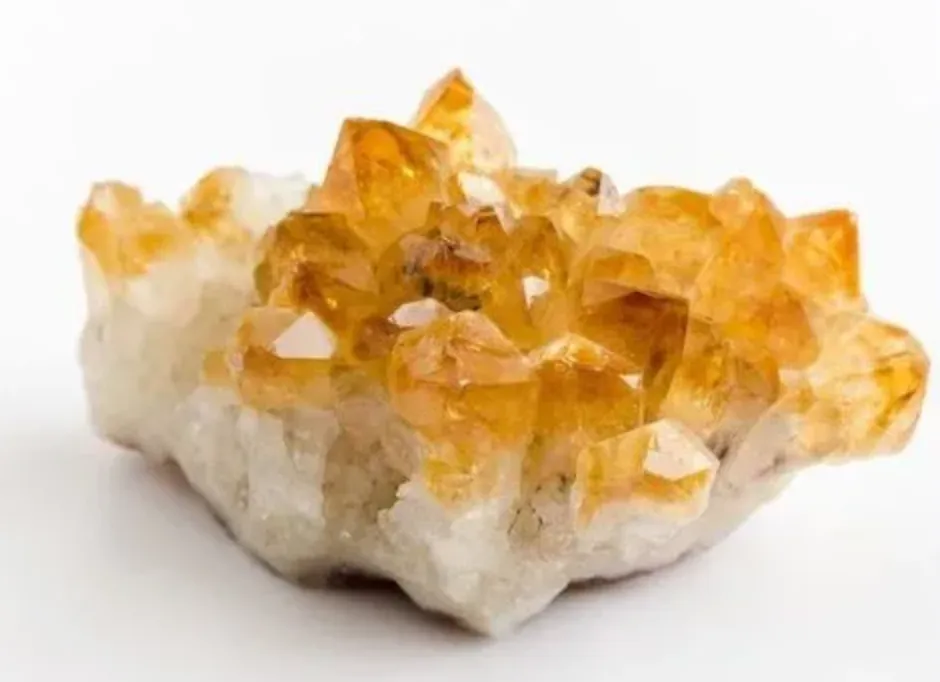
Topaz & Citrine: November’s Golden Birthstones
Welcome to our Birthstone Blog Series! At the beginning of each month, we take an in-depth look at that month’s birthstone—or birthstones, if there is more than one.
Set into bracelets, earrings, pendants, and rings, Topaz and Citrine offer a radiant way to celebrate November birthdays. These sun-hued gemstones have long been admired for their warmth, brilliance, and rich history.
If you have any questions about topaz or citrine, the team at Redlands Jewelers would love to help—feel free to stop in or give us a call.
November Birthstones: Topaz & Citrine
Two golden gemstones, two glowing treasures. Though Topaz and Citrine are completely different minerals, they have been closely associated throughout history due to their similar warm, golden tones.
Topaz has the chemical composition Al2SiO4(F,OH)2, while Citrine is a variety of quartz with the formula SiO2. Together, they represent light, joy, and abundance.
Topaz During Ancient Times
Topaz has been valued for centuries for its honeyed hues. Ancient Egyptians associated the stone with the sun god Ra, believing it carried the power and protection of the sun. With a hardness of 8 on the Mohs scale, topaz has long been appreciated for both its beauty and durability.
In ancient times, topaz was rumored to be worn only by royalty and imperial families, further enhancing its prestige.
Stories and Lore of Topaz
Throughout history, many meanings were attributed to topaz. The Ancient Greeks believed it granted strength and protection from illness. In India, topaz was worn above the heart to promote longevity, beauty, and intelligence.
The Romans believed topaz could detect poisons, changing color when placed near tainted food or drink. During medieval times, Cardinals and Bishops wore topaz as a symbol of purity and goodness. In the European Renaissance, people believed topaz could dispel anger and break magical spells.
A History of Topaz Mining
The name “Topaz” comes from “Topazios,” an ancient Greek name for an island in the Red Sea. Though a green gemstone was once found there, it was not topaz. The island is now known as Zabargad and is part of Egypt’s Elba National Park.
In the 17th century, sunset-colored gemstones discovered in Russia’s Ural Mountains became known as Imperial Topaz and were once reserved exclusively for Russian royalty. Today, Imperial Topaz is prized for its natural hues of orange, red, yellow, pink, lavender, and peach.
Although Russia is often associated with Imperial Topaz, many of these stones were actually sourced from Brazil, which remains one of the world’s primary producers of topaz.
Gemstone Treatments
While clear, colorless topaz is abundant, natural blue topaz is extremely rare. In the 1960s, new irradiation and heat treatments were developed that could turn colorless topaz blue. These treatments allow for a range of blue shades and are stable and permanent.
Topaz is one of the most commonly treated gemstones. In addition to heat and irradiation, some stones receive surface coatings, such as titanium, creating a metallic shimmer. While visually striking, coated stones require extra care as the surface can scratch more easily.
Today, most topaz is mined in Brazil, though it is also found in Russia, Sri Lanka, Japan, parts of Asia and Africa, and in smaller quantities within the United States.
Story of the Braganza Diamond
Around 1740, a massive clear stone was discovered in Minas Gerais, Brazil, and believed to be a diamond. The Portuguese sent it to King John VI, and it became known as the Braganza Diamond.
The king reportedly had a hole drilled through the crystal and wore it around his neck on special occasions. Years later, it was discovered that the stone was not a diamond at all, but likely a massive topaz.
Though rumors claim it was set into the Portuguese crown, this is inaccurate—no gemstones are mounted in the crown jewels. The Braganza Diamond eventually disappeared, possibly hidden to avoid public embarrassment over its true identity.
Interestingly, a few years later, a faceted stone weighing approximately 819 carats appeared in France and was also thought to be a diamond. It too was determined to be topaz or quartz. Whether this was the missing Braganza remains a mystery.
Start Shopping Today
We’re excited to share this next chapter of Redlands Jewelers with you. Whether you’re shopping for a special gift, dreaming up a custom design, or simply browsing, www.RedlandsJewelers.com is your go-to destination.
You can also visit us in person at our downtown Redlands store, where we’ve proudly served our community since 1971. Now, you can enjoy the same trusted service and quality online as well.
Here’s to celebrating life’s moments—big and small—with jewelry that shines as brightly as you do.